Some sporadic insights into academia.
Science is Fascinating.
Scientists are slightly peculiar.
Here are the views of one of them.
Buy My Book

Friday, 17 July 2015

The 4 elements of Academia


Professor Beardyman

Just to show I am down with the youth, I am going to compare academia to hip hop. As you all know, there are 4 fundamental elements of Hip-Hop. You knew that didn’t you? You didn't? Oh allow me to educate you – they are:
Beardyman: Though the beard may be a bit oversold

1. Bboying
2. MCing
3. Graffiti
4. DJing. Obviously.

Why am I showing off my Vanilla Ice like knowledge of the patois of modern culture? Well there are 4 elements to academia, publishing, grant writing, teaching and admin. In my quest to inform the great unwashed (yes that’s you, the one not really paying attention in the back) about what academics do, this week’s tortured musing is going to give an overview of why we think these elements matter. Though you will be pleased to know I am not going to stretch my torturous analogy to linking say Grant writing to B-boying – mainly because I don’t know what Bboying is!

Zen and the art of university maintenance

There are 3 ways of viewing the elements

Idealistic: Universities are dreaming spired bastions of learning and higher education where we educate young minds, push back the boundaries of knowledge and enrich the greater good by applying Kantean dialectics to the routes of the romantic poem. In this worldview teaching is central, admin is giving back to the university, paper writing a joy and grants a dirty word as there should be an inherent understanding of the intrinsic good our esteemed institutions do.

Fatalistic: The economy is fucked, George Osborne is busily grinding the last traces of state funded endeavour into a dry dust of free market neo-con fury. In this less than enlightened time, we have to pay our way and our work has to have IMPACT (if there was an option to make the word flash and somehow sear itself into your skin, that would be the font I should use, but a whole other blog is needed to talk about IMPACT). Our work is publicly funded from hard working honest tax payers' money and we should never be allowed to forget it. The university is a business and every action should be to support the mission statement and bring money into the university.

A third way: Like the force, there needs to be balance in the univers(ity). The money that pays for our salaries does come from somewhere and most of it comes from the taxpayer. In return I need to do something more productive than watch Beardyman videos on YouTube (though the kitchen diaries is awesome). Academics do need to contribute to the running of the place and the education of the students. But at the same time we should be in a position to carry on researching the relative importance of early-latin swear stones (if we wish).

The academic transfer market (my one paragraph of soapbox ranting)

These different approaches have an impact on university life. As with all educational institutions in the UK, universities are ranked and what does ranking bring…Prizes (or substantial funding from the government in the form of QR and QT grants from the Department for Business, Innovation & Skills, but prizes is more catchy). They are ranked on a number of different criteria, but the two big ones are the REF (a quinquennial exercise evaluating research output and IMPACT) and the QA (which evaluates teaching). These evaluations are based on individuals, which generates a transfer market in academics, with the superstar professors moving between the big universities demanding more space, more salary, more acolytes and flunkies to peel them raw grapes. This can have a number of negative repercussions: focussing resources on a small handful of individuals, damaging departmental cohesion, depleting the pension pot (which was final salary based) and putting academic career development at a lower priority – why train people when you can just buy someone in. The other concern is just because they are big hitters doesn’t mean they are team players and the perceived benefit of what they bring may be offset by the friction and resentment they cause. To crunch metaphors, we should aspire to have more Stephen Gerrards (who played for one club his whole career, possibly to the detriment of the amount of medals he won), people who grew up in one institution are to my mind, more likely to be loyal to that institution, understand the culture of the institution and are more inclined to contribute in the small ways necessary to keep it running. Then again, we can all get a bit inward looking and fresh perspective always helps.

Nick Clegg and the new student generation.

Crikey, got slightly off topic there. Must. Focus. 12 months ago I would have said that successful grant writers will inherit the ivory towers. They were perceived to bring in cold hard cash that pays for the buildings, the electricity, the salaries of the people who work in the mystery blue box (and as a sideline get a small bit of money to do research). However, times have changed, and the quants who run the institutions have realised that students = money: £9,000 x as many people you can squeeze into a lecture theatre per year. This has the beginnings of a major revolution in universities. Firstly (and don’t tell them) this gives the students real power as consumers, if the teaching is not up to scratch they can head to the twitterbookapp thingy and troll the course – luckily most of them are too busy being students to realise this empowerment. Secondly, those who teach and particularly those who teach well, suddenly have become more valuable. With the increased focus on teaching, it is possible that the superstar teachers will now also be commoditised and traded between the colleges. I suspect we are a way off Panini doing a sticker album of high flying academics, buy maybe academic top trumps is not too inconceivable! Imagine the fun - oh no I can’t believe you beat my Nobel Prize winner with your senior administrator.

Not so Deep Conclusion

Academics need to deliver a range of diverse functions within the space of the working day (like most jobs). I would argue that the breadth of skills required is unique, ranging from preparing sales pitches to writing technical literature to teaching to management. Then again I have no experience of any other job, except stacking shelves in a refrigerated warehouse, so have little to compare it against. There are some people who excel in a single area and are prized by the institutions, but the rest of us have to muddle by with a mix of all aspects. 

To entice you to come back soon, the next few editions of this blog will unpack each element (dreadful business speak fail) and what is involved in them, probably, or I might just talk about my lunch – again.

Tuesday, 30 June 2015

Break the bug, spare the child. The partial attenuation of Small Hydrophobic (SH) gene deleted RSV is associated with elevated IL-1β responses.

Maurice Hilleman
Hero of the 20th Century
Many of our best (and oldest) vaccines are based upon a principle called live attenuation. This is where we have somehow modified the infectious agent so that it is less infectious, allowing the body to kill it and generate an immune memory in order to be fighting fit on exposure to the real thing. Historically, this process was achieved empirically (by trial and error), either by using an equivalent bug from a related animal for example – Cow Pox/ Small Pox. Alternatively the bugs can be serially passaged – grown in conditions that cause them to lose the genes that makes them infectious– e.g BCG/ TB . Or it can be done in a more targeted way, for example the live flu vaccine was developed by selection for growth at 32°C – closer to the temperature of the nose than the lung and therefore limiting infection to the nose causes colds at worst rather than lung infections. The master attenuator was a microbiologist working at Merck called Maurice Hilleman, who is probably the most influential person you have never heard of – saving more lives in the 20th century than any other person. I just want to emphasize his importance, because his record is often under stated, Hilleman invented 8 of the 14 vaccines we use today and yet, I had to google him to remind myself of his name.

However, we are now using more targeted approaches to attenuate viruses and bacteria. This is based on our improved understanding about how pathogens are able to infect people. For example what do they look for on the surface of cells to invade them, how do they coerce the machinery of the cell to make copies of themselves rather than more cells and critically how do they hide from the immune response. All human viruses have evolved ways of escaping the immune response (immune evasion), viruses that are not able to escape our immune response are not able to infect us – that’s why for example we don’t get myxamatosis from rabbits. In our recently published study in the Journal of Virology, we discovered a new immune evasion function for a gene in respiratory syncytial virus (RSV). RSV is a really important disease in children, causing 160,000 deaths worldwide and hospitalising 1% of all children under 1 in the UK (including my son).


The gene we were interested in is called SH (or small hydrophobic gene – sadly whilst drosophila geneticists get to call genes things like sonic the hedgehog and LUSH, we get names based on the structure or function, or sometimes just the order they were found). It is believed to make a small hydrophobic protein (can you see what we did there!) which folds up to make a pore or tube like structure. Based on other studies using similar proteins from other viruses, we hypothesized that this protein would actually alert the immune system, so we were surprised to find that infection with RSV lacking SH (RSV ΔSH) led to MORE of specific type of signal rather than less. We then saw that if this signal was blocked, the virus – which previously grew less well in lungs, grew to the same level as unchanged virus. We think this might be important both in our understanding about viral biology and possibly in developing strategies to make targeted vaccines. We were supported in this work by two grant programs from the EU, Aditec and Biovacsafe, which has enabled a lot of the work in the lab to be performed.

Monday, 22 June 2015

What's the difference between a Jelly fish and a vaccine?

A Comparison of Red Fluorescent Proteins to Model DNA Vaccine Expression by Whole Animal In Vivo Imaging

PLOS One, June 2015

Vaccines are an incredibly potent tool in our arsenal to prevent infections. Simplistically they work by exposing the immune system to a safe part of the infectious bacteria or virus and evoking a memory response. When the vaccinated individual encounters the actual bug in real life, this memory allows the immune system to recognise and respond to the bug faster, thus preventing the infection before it takes hold. A critical step in vaccine development is the identification, isolation and mass production of the parts of the virus and bacteria that are able to evoke an immune memory. These components are often made up of proteins, which can be problematic and expensive to make to a standard that is acceptable for use as a medicine. Recently an alternative approach has been developed called DNA vaccination, which we describe in this review. DNA, the material of genes, contains the coding message for the production of proteins by cells. In the 1990’s a number of groups made the breakthrough observation, that if you inject DNA encoding proteins from a pathogen into a mouse, the mouse will make the protein in its cells and generate an immune response to this protein. This technique has the potential to significantly change vaccines because it is cheaper, easier and faster to make, for example, if a new viral epidemic occurs e.g. Ebola or MERS-CoV the time to make and test a DNA vaccine could be significantly shorter and therefore the spread of the disease would be reduced.

The rainbow explosion of fluorescent proteins, From Roger Tsien's Nobel Prize Talk.
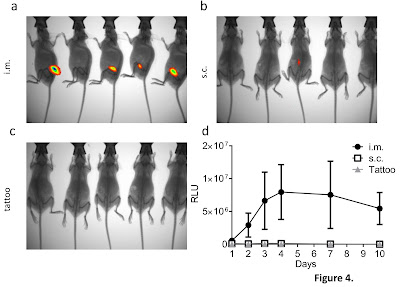
However, DNA vaccines have performed poorly in early phase clinical trials (i.e. they work really well in mice, but poorly in people). There have been a number of reasons proposed for this failure, but one possibility is that, after immunisation, the genes encoded by the DNA vaccine are not turned into protein by the patient (technically referred to as poor expression). In our recent paper, we set out to address this problem in our study, using a novel technology called in vivo imaging, which uses the proteins that allow jellyfish to glow in the dark and fireflies to flash at night. The original fluorescent protein was green (named green fluoresecent protein), but since then a whole colour chart of proteins has been developed with names like tdTomato and mPlum. If the proteins are injected into mice, they can, using a special camera, be seen. The colour of the protein has a significant impact on our ability to see it in mice, blue and green proteins work poorly because the skin has evolved to reflect light in these wavelengths as a defence against damage caused by UV light. Red proteins tend to be better and in our recently published paper we tested a range of red proteins delivered as DNA, called tdTomato, mCherry, mKatushka and tdKatushka. We observed that only tdTomato gave us a strong enough signal to see in the mice and that there are number of confounding problems with the approach – pens we use to identify individual mice fluoresce in the same colour as mouse poo.


An Unusual Location for Scientific Training!
Delivering the DNA by different routes also had an impact on the brightness with DNA injected into muscles producing a brighter signal than DNA injected into the skin. We also looked into alternate methods of delivering vaccines trying to more directly access cells involved in the immune response. One approach we tried was tattooing, which is exactly as it sounds, we tattooed DNA directly onto the skin of mice using the same system as you might get an anchor or ex-girlfriend’s name tattooed on your arm. This came as a kit and to get training, Katya (the lead author) had to get help from the local tattoo parlour on Praed St! Delivering the DNA that expressed the red proteins by tattoo failed to induce any signal, but when we used it to deliver a vaccine, the mice were protected against influenza infection. However, this result needs some caution as the equivalent body surface area in a person would be the entire upper thigh!


Visualising Luciferase transfection in vivo
This work was supported by the Medical Research Council (MRC) as part of a CASE studentship (collaborative awards in science and engineering). These awards are a collaboration between academia and industry, with the industrial partner providing a novel product or technology and expertise in that area and the academic providing the capacity to perform in depth, slightly more esoteric research. The scheme is mutually beneficial as the academic partner gets a student to pursue novel areas and the industrial partner gets to explore angles that would not necessarily fit within the usual timeline constraints of getting products to market. We have been collaborating with a biotech startup called Touchlight Genetics who have a novel process for generating DNA without bacteria. As part of this collaboration, we have previously shown that the DNA is as effective as conventional bacteriaderived DNA and we are working to develop new vaccines with the technology. Overall, we conclude that imaging protein expression from DNA may be useful for some applications, but is poorly predictive of vaccine efficacy.

Monday, 15 June 2015

#DistractinglySexy. Gender Bias in academia.

Distractingly Sexy

An incorrect assertion


“'Let me tell you about my trouble with girls.Three things happen when they are in the lab: you fall in love with them, they fall in love with you, and when you criticise them, they cry." Prof Tim Hunt (attrib).

The first I knew about this story was an email from my Dad saying to be careful of what you say and to whom and the trouble you can get yourself.

Sensible Advice.

That I will now ignore and blindly enter the minefield of writing about women in science as a man. I cannot fully appreciate all of the challenges associated facing women in the workplace and there are obviously better informed people than me who have done more reading and research on both the problems and the solutions. So why write this? Because the system is broken and we need to fix it, because I am inclined to value my own opinion and want to share it (one of the defining features of being an academic) and because I want to add my voice to people saying things need to change.

The fault in our stats


Figure 1. Staff at UK HE providers by occupation, age and sex.
Taken from Staff in higher education 2013/14 (https://www.hesa.ac.uk/pr212)
The comments attributed to Professor Hunt reflect a wrong, but not unique view in science and therefore underlie a massive problem in academia. This bias is then further exacerbated by the uneven numbers of women and men in senior academic posts. This data from HESA (Higher education statistics agency) demonstrates the current situation. 45% of academic staff were female, but at senior levels women made up 22% of professors, and 33% of other senior academic staff. The majority (63%) of non-academic staff in 2013/14 were women, including 54% of managerial, professional and technical staff and 82% of clerical staff.

Why do things have to be like this?


A question is why is there such an imbalance? In part it may reflect a historical bias, with the environment in the 1980’s and 1990’s being even less supportive than it is now. I had the privilege of knowing Prof Ita Askonas, who passed away a couple of years ago, a truly remarkable, supportive academic mentor, who rose to the top of her field in a generation when this was far from the norm, but she was one of a very small handful of female academics in her generation. There is some evidence of an upward trend – in 2004 only 21% of clinical academics were women, slowly rising to 26% in 2011 and 28% in 2013, with professorships at 11% in 2004 and at 17% in 2013 (medschools.ac.uk), but it is slow progress.

But historical bias is not the whole story and there are other factors. I would put children and childcare near the top of the list. There is still a perceived bias in expectation towards mums taking time off rather than dads. This is a whole complicated issue and which someone should address separately in a well rounded, but witty blog post . The MRC’s recent change to make fellowship eligibility independent of time post-PhD is a big positive step in this regards. There are some well described unconscious biases in recruitment, job advert writing, interviewing. There are self-reported biases in science by academics of both sexes (good nature op/ed article here). But the prevalence of gender stereotyping may unfortunately be propagating this bias. For example, Larry Summers (then President of Harvard) infamously commented on aptitude and gender (for fuller details see here) and a very brief dip into the interweb brings up, for example, an article about the coconut genomes from The Journal of Proteomics. An unlikely source of sexism, until you see the graphical abstract depicting a woman holding up two coconuts against her chest for no obvious reason (from http://www.stemwomen.net/recognising-sexism/).

I will re-iterate, opinions about the relative aptitudes of people based on what they are, are wrong. People make good (and terrible) scientists, regardless of race, sex, sexual orientation or background. It is also wrong to stereotype about lab personalities, for any given “but type X people are more likely to behave in Y way”, I can give you multiple examples of the opposite. These are wrong views and as trainers of the next generation (and parents of the one after that), we need to dispel them. At the end of the day, science – and the world that depends on scientific progress, needs the best qualified/most able people to deliver it.

It’s my laboratoire


The fact is that for multiple reasons it is harder to be a woman in science. Therefore things need to be done to level the playing field or we will not get the best people. However, it is easy to see why some people may not (consciously or subconsciously) want the status quo to change. Full disclosure: I am a white, privately educated, Oxbridge graduate, man. If 2 men are appointed to every 1 woman, then my chances are much improved. Any levelling of the playing field, could make the path harder for me and those like me. Whilst I assume my genius, social skills and zingy personality got me where I am, I have had every possible advantage from a loving home to extra golf lessons. There are some schemes and support networks, for example Athena Swan and awards targeted at women, or women coming back from childcare breaks but they are few and far between. Sadly, it is not uncommon to hear young male academics/ post docs/ PhD students complaining about how unfair these schemes that preferentially support women are. Interestingly these type of comments tend to tail off with age as these same young men see the problems their friends and loved ones go through juggling children and work. Optimistically, I think these complaints are a direct consequence of the terrible funding situation rather than the next generation of bigots being made. There is so little money available, that any factor that puts you at a perceived disadvantage seems outrageous. I do my best to point out the error of their ways, but it is a view point that needs to be changed. It probably doesn’t help that one of the schemes is sponsored by Loreal (brilliant Mitchell and Webb sketch on this).

We found love in a hopeless place


Was there any truth in the comment: "you fall in love with them, they fall in love with you". Yes, some people do fall in love in lab settings – I met my wife doing my PhD and many of my friends met their partners in science. But then again, many of my other friends met their partners in the army, being doctors, accountants, lawyers etc and then others met in bars, on Tinder, Grinder and Gap years in Africa. If you put people together, some of them will end up sleeping with each other.

Boys don’t Cry


Science is stressful, repetitive and mostly doesn’t work. PhD’s are more so, because you are learning and feel under a time pressure. Hindsight and experience are potent – of course I wouldn’t have done it that way, I would have included that control, I would have put the right chemicals in in the right order. Except when I am actually doing the labwork and adding my own unique cock ups to our long list of ways to fail at ELISA (we are currently at reason 20 – wrong species: long story/ different blog). Bosses are unsympathetic, under stress themselves and often just had a grant rejected. Even worse, Bosses also have a rose tinted view of how easy lab work was in their day, which with incomplete hindsight it possibly was, what was cutting edge to me is now provided in a kit to my students. All of this can add up to toxic interpersonal interactions. Some people cry, some people smash keyboards, things happen, to everyone. So again, an incomplete observation.

Amazing pithy conclusion


Sadly I don’t have one. There is a sex bias in academia (and many professions). It may (or may not) be improving. Changes need to be made, to make it fair so that selection is entirely on aptitude and ability, because science as a career is hard enough, without disadvantaging 50% of scientists. On the minus side there is still bias out there: on the plus side (some) people on twitter are provocatively funny (#Distractinglysexy), reminding us that the more we discuss workplace biases and educate the next generation the less likely it is to be perpetuated.

Post:Script Backlash against 140 characters

I have slightly amended this piece since I first posted it, due to the toxic backlash against Professor Hunt and the complexities of understanding what someone said when you only see a small snippet of it. I put this down to my naivety of social media and not truly understanding the impact it can have until I read Jon Ronson's brilliant - So you've been publicly shamed. The changes I made have left the sentiment intact (academia should be more fair), but in a less accusatory tone.


Thursday, 21 May 2015

International travel, exotic locations, meeting new people. The cross we bear.


Interests: Travelling


The science park, Gdynia.
Not quite Croydon
After screening job applications, I began to wonder why so many people have “interests: travel” on their CV to make them sound more unique and thought? Oddly, no one ever puts interests: business travel, probably with good reason. Business travel is really no fun, admittedly this is a massive #middleclassproblem, but. Going somewhere “new and interesting” for work sounds amazing, but when you arrive only to stay in an identi-kit business hotel in a science park on the outskirts of somewhere that looks a little bit, but not quite like Croydon, the shine goes off. My nadir experience was spending less than 24 hours in Gdynia (Poland), apparently the twin city of Gdansk, in the middle of winter. Gdansk, so the guidebook tells me, is a beautiful example of eastern European mediaeval architecture, Gdynia – less so. All I saw was the airport, some rain, a Tesco, a science park, some snow falling whilst my taxi driver drove at >10000000 miles an hour, Gdansk dock in the dark and the airport. At least there are connecting flights from London (Luton), so I only had to drive for another 2 hours to get home, rubbish.

Another day, another Novotel.

2 stand up guys in Bangkok

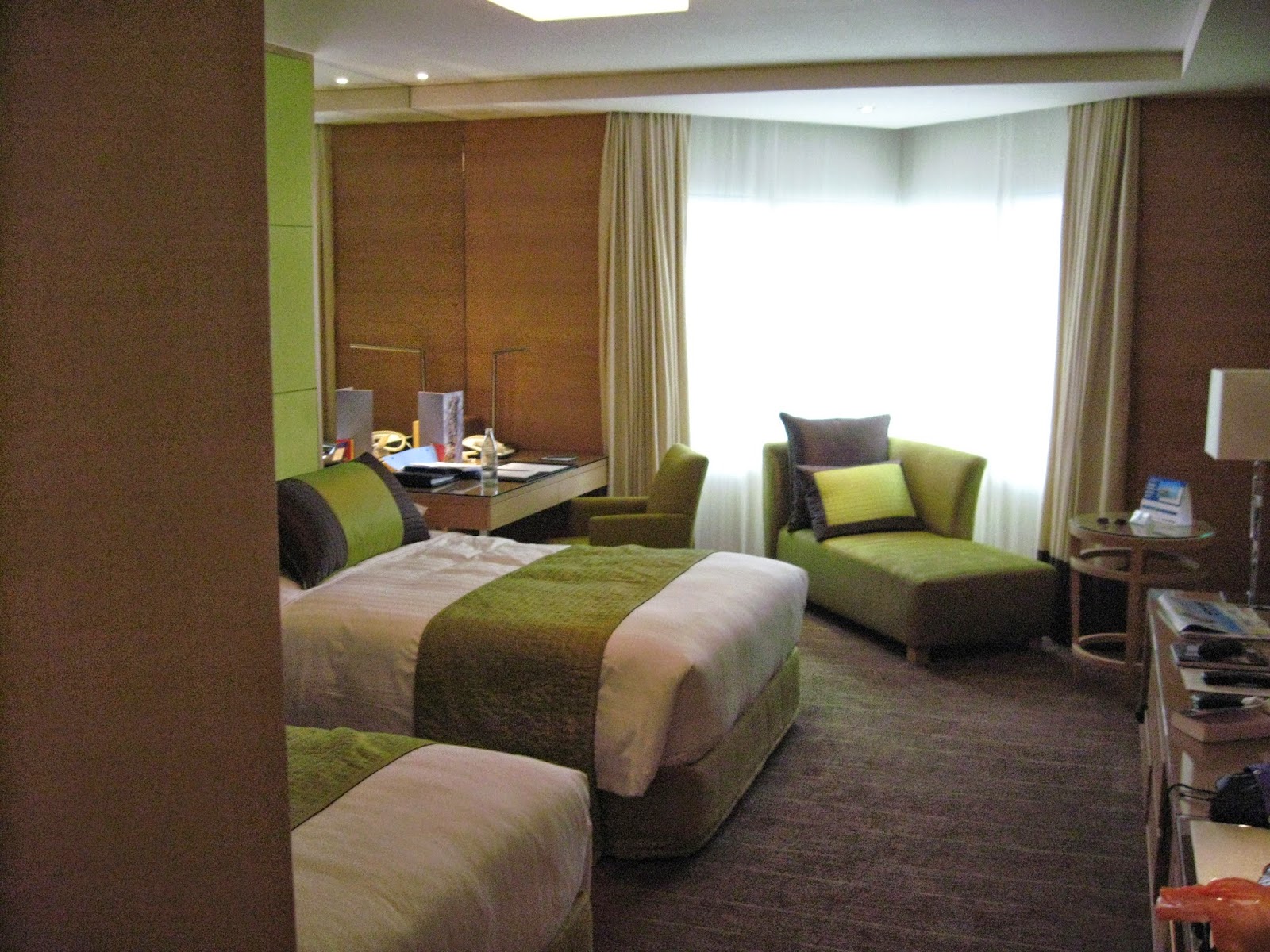
One of the soul destroying features of business travel is the decision by someone to make all business hotels look the same. Except the shower controls, which are always different but have only 2 settings, too hot or too cold. When the decision was made to make all hotel rooms look the same, did they decide that two king sized beds was necessary and more worryingly, what were they last used for? On one trip to Bangkok, a Thai friend with whom I did my PhD escorted me round her home city. Turns out that to most people white man, Thai woman means a different kind of escorting. When we got to the hotel I was told very politely that ‘extra guests’ were not allowed. Now this was mortifying on a whole number of levels. Firstly for my friend who is an academic running her own lab and was horribly pigeonholed because of me, secondly for myself for apparently looking like a western sex tourist but finally for my night’s sleep and the hope that the sheets get well laundered if this is a common problem. PS answers, she isn’t, I am not, they do. It’s not only that these hotels are all the same, it’s also that they are all not home and inevitably I have a sub standards night sleep, because it’s either too hot, too cold, pillow’s too hard or not (even with the pillow menu), bed’s the wrong shape, there’s a pea under the bottom mattress, I ate something with coffee in sometime earlier in the week etc. On reflection I might be a fussy sleeper.

The king of rock and roll

Thanks Courtney, that looks lovely pet
I could go on about the enumerate, ungrateful petty problems I have when I am travelling, But this has all taken a slightly unfunny, Michael Macintyre-stating the bleeding obvious-it’s funny coz its true riff. Instead, I will admit a lot of my whinging is for ‘comic’ effect – and because I like the sound of my own voice, even on paper. There are, to be honest, a number of positives about travelling with work. The biggest one is that you get to pretend you are a Rockstar, admittedly not a huge cocaine snorting, 18 girl orgy, room trashing, TV out the window, rolls Royce in the swimming pool, Keith Richards/Keith Moon/Axel Rose/Tommy Lee Rockstar. To be honest it’s a bit closer to being James Blunt, but he’s still a Rockstar (and does have an awesome Twitter response history). Leaving clothes on the floor, not making the bed, leaving the lid of the toothpaste tube and coming back to find the room immaculate, amazing. It is just possible that my aspirational Rockstar status is a bit adrift from reality, but I bet Kurt Cobain never put the lid on the toothpaste – that’s probably why Courtney Love shot him. Like I said, not superstar stuff, but still quite a treat, especially when you spend most of your time clearing up after wayward children and PhD students. Having low expectations helps.

How to win at travel

Asides from the low budget Rockstar fantasies, there are a number of things that do make life on the road endurable:

Skype (other free video conferencing software is available)

One of the toughest things is being away from your family. In the not so distant past, staying in touch would have meant acquiring handfuls of small change, then standing in some freezing, piss filled phone booth or paying exorbitant hotel dial out rates. Now with the ubiquity of smart phones and Wi-Fi you can video link into the heart of the home at the most inconvenient times – bath time is best – to remind yourself of the chaos you have left behind at home and that being away from it for a few days is probably not so bad.

The Euro

I am not entirely clear about the economic arguments, but having one currency for every country I go to is amazing. It means having a wallet preloaded with some kind of monopoly money which you can use for every trip. Until you go somewhere in Europe which isn’t in the EU. (NB John’s travel tip – they use Krone in Iceland)

Running

One way in which I differentiate between different places is to go for a run. Again t ’internet is a Godsend as with the help of mapping apps you can find a reasonably decent run. Normally around some of the finer turn of the century soviet era light industrial estate in the rain, but at least you see something to indicate you’ve left home.

Being fussy

One thing I only recently discovered is that you are the customer. If you are from outside England, this is probably not a revelation, but to us it is mind blowing. Rather than meekly putting up with a pokey garret next to the lift with a broken toilet, I have started asking for a quiet room at the outset and if it is no good going back and asking for another one. This has considerably upped the quality of the experience.

Amazing things sometimes happen

Swimming in a glacial melt river in Iceland that has been heated by volcanic run off to bath hot temperature whilst being paid by the EU. If every member of UKIP got to do this I think they’d soon change their tune.

Beer

Drinking Belgian beer with Danes at 2 in the morning… what could go wrong?